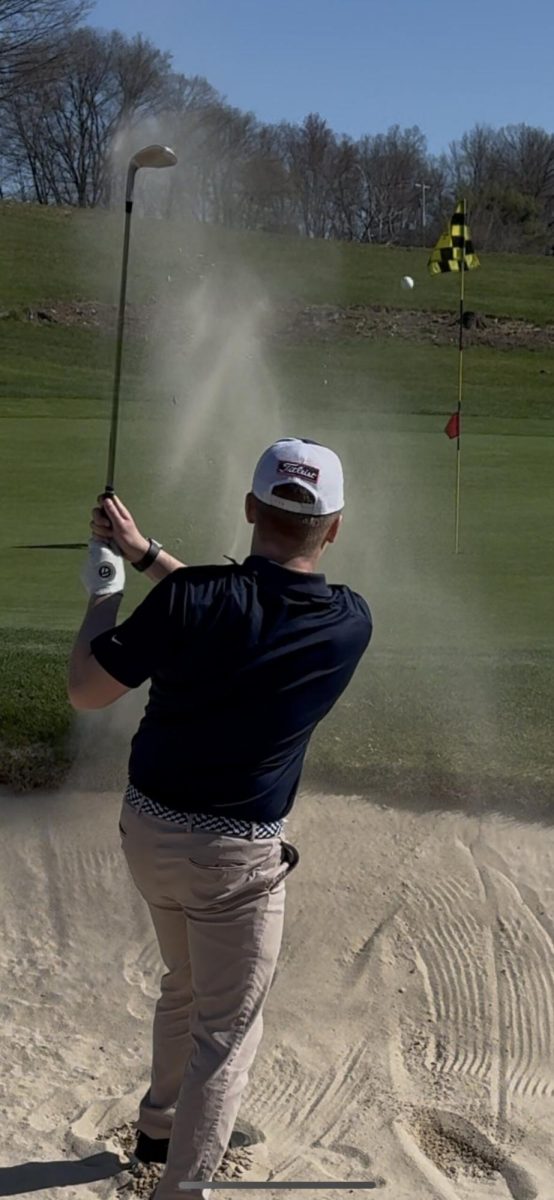
When approaching the green, golfers are met with two challenges: chipping and putting. Short game is where golfers waste the most strokes, mainly from flubbed or skulled chips, and multiple putts to get the ball in the hole.
A lot of pieces come into play when it comes to the short game, such as proper alignment with the ball, correct swing path, and making sure the clubface is perfectly straight right on impact, and where the ball lies.
According to Professional Golf Association (PGA) statistics, golfers waste between five and 12 strokes in a round, causing them to shoot higher scores and affecting their way around the course.
However, there are ways to improve when approaching the green and reducing strokes from the scorecard, such as putting and chipping techniques.
Sophomore Aidan Carlson says, “I usually walk up take a look at the lie and see how I can put it close to the pin like flopping it on to the green or bump and running it then before I hit the ball I do two to three practice swings then I take one more look then I walk up get into position and hit the ball.”
Chipping is usually done with a wedge, ranging from 56 to 60 degrees of loft, and is used when right outside of the green. It is a swinging motion, where the club is meant to strike right behind the ball, so the club face loft lifts the ball off the grass and lands onto the green.
When hitting out of the sand, it is much different. The player lines up to the ball at the front of their stance with all their body weight on the front foot, and the club goes up in the air almost at a 90-degree angle, then immediately strikes downward. Then, the club makes contact with the sand two inches behind the ball, causing the ball to go straight up into the air and land on the green.
Many find chipping to be a weak part of their game, but it can be improved by constant practice, analyzing swing paths, and the way the golfer strikes the ball.
Junior Owen Trice says, “I practice chipping by hitting balls into a net in my backyard. I focus on short, smooth swings and good contact. Sometimes I go to the practice green at The Orchards Golf Course and chip in from different spots to try to get it close to the hole.”
When it comes to putting, it is a pendulum motion, where the player swings the club back one way and finishes the motion by striking the ball and following the path of the club. The fewer the putts, the better the score.

The first challenge that comes to mind is reading the green. Reading the green is very complex and challenging due to uneven terrain and how the ball is going to roll. So, players need to visualize the terrain, line the ball up and aim, and trust the line of view where the ball is going to go.
The number of putts is a confounding variable, causing higher numbers on the handicap index. Many golfers practice their putting through distance control and accuracy because it leads to better putting strokes.
Senior Mark Berlen claims, “I practice my putting by spending sessions at the green. I drill specific drills with tees and alignment sticks to practice speed and tempo.”
Whether working on putting and/or chipping, consistency plays a key role in the success of short game. Taking practice swings, lining up the ball, doing drills, and even chipping into a net can help lower the scores on the card and the handicap index.