January 27 marks Holocaust Remembrance Day, a time to reflect and commemorate the lives lost during the Holocaust, to honor the survivors, and to reaffirm our commitment to remembering history so that such atrocities are never repeated.
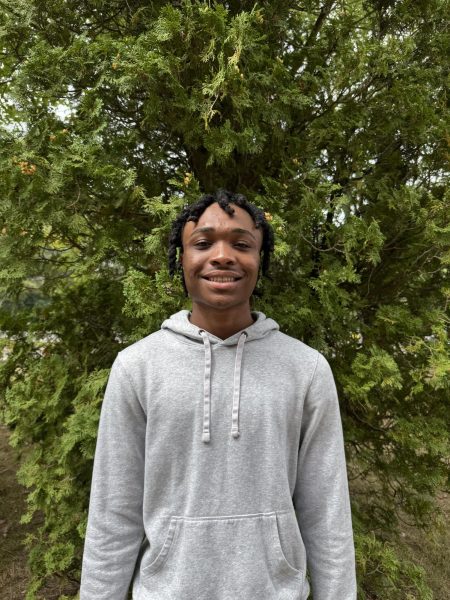
Izzakhar Larkin, a senior, believes people should know more about the Holocaust.
“I think people should understand the motives that led to the Holocaust and why such a horrific thing even happened in the first place,” Larkin said. “Genocide isn’t good regardless of the intention.”
Larkin has a personal connection to the Holocaust: while his direct family avoided the concentration camps by immigrating to the United States in the 1920s, other family members were not so lucky.
“My uncle married into our family, and his parents were born in a camp,” Larkin said. “None of my bloodline experienced the camps, but it’s still something that affects us.”
When discussing how the Holocaust impacts society today, Foran High students pointed to the importance of education and awareness. Larkin emphasized that history must be taught honestly and without censorship.
“I feel like it should be taught straight up, no censorship, so people understand the reasoning and severity of the Holocaust,” he said.
Each year on Holocaust Remembrance Day, January 27, communities pause to confront the Holocaust, one of history’s darkest chapters, and to honor the eight million lives lost. Among those lost were six million Jewish people and two million others targeted for ethnicity, beliefs, disabilities, and identities.
Joseph Kerzner, a senior at Foran, said the Holocaust “definitely” impacts Jewish people today. “People should understand the Holocaust today because it was one of the worst mass murders in the history of the world, because of one thing: people were Jewish.”
“It is heartbreaking,” Kerzner added. “I see antisemitism nearly every day on social media, and it is heartbreaking to see, knowing that it is my religion being targeted.”
The Holocaust is taught in several courses within Foran High School’s curriculum, and the school holds an annual assembly in recognition of Holocaust Remembrance Day. During the assembly, students hear from Holocaust survivors and family members who share their experiences from that time period.
In recent years, Foran met Susan Unrad, daughter of Holocaust survivors Elmer Zeif and Gizella Grosz. She told students that her father was taken in June 1942 by the Nazis, separated from his family, and loaded onto a train to a labor camp. At the labor camp, he was forced to march to Siberia, remove valuables from the dead, and participate in very hard labor.
Her mother was taken to Auschwitz, a concentration camp. Her head was shaved, and she was given little food and was also forced to do hard labor. Later, she was sent to a labor camp until she was liberated in 1945.
Elizabeth Deutsch of Fairfield is another person who has spoken at Foran, recalling the horrors at the Auschwitz-Birkenau camp. She recalled Josef Mengele, nicknamed the Angel of Death, an SS physician infamous for his inhumane medical experimentation on concentration camp prisoners at Auschwitz, according to the Auschwitz website.
Deutsch said she saw him when she entered Auschwitz-Birkenau: She said it was he who started the selection process, who pointed them to the right or to the left. She was sent to the right with her sister, Frieda, nine years older than her, but her mother, aunts, and cousins were sent to the left, a line that led to the crematorium.
The images and stories that people have shared about the Holocaust are vital to understanding that dark period in history, history teacher and department head Mr. AustinCesare says. “It is so powerful to hear from survivors and their families because it is very important that students see and hear from those who experienced the horrors of the Holocaust firsthand and what people went through living during that terrible time period,” says Cesare. “It is important that people always remember, and they never forget.”
Visiting the United States Holocaust Memorial Museum in Washington, D.C., a few years back with Mrs. Lisa Farrell’s class was also very powerful, Cesare adds. “This was such an impactful trip for students and their chaperones to have the opportunity to visit there and see firsthand the many testimonies, exhibits, and artifacts that are part of the museum.”