Technology is evolving day by day, not just in the real world but in the classroom as well. Artificial intelligence (AI) is no exception. With AI becoming more prevalent and advanced, it’s important that students and teachers are able to use it responsibly and ethically when attempting to lighten their workload.
AI has been growing over the past couple of years. Since late 2022, ChatGPT has grown to be one of the largest AI tools around. ChatGPT is a chatbot that allows users to “chat” with it. ChatGPT is currently on version 5.1, and with this, it is able to generate images when given a prompt.
With its rapid development, ChatGPT and other AI models have become more widespread in the classroom. Students have been able to access it and use it for academic assignments. ChatGPT, despite how popular it is, is not the most accurate, which is a major issue in school.
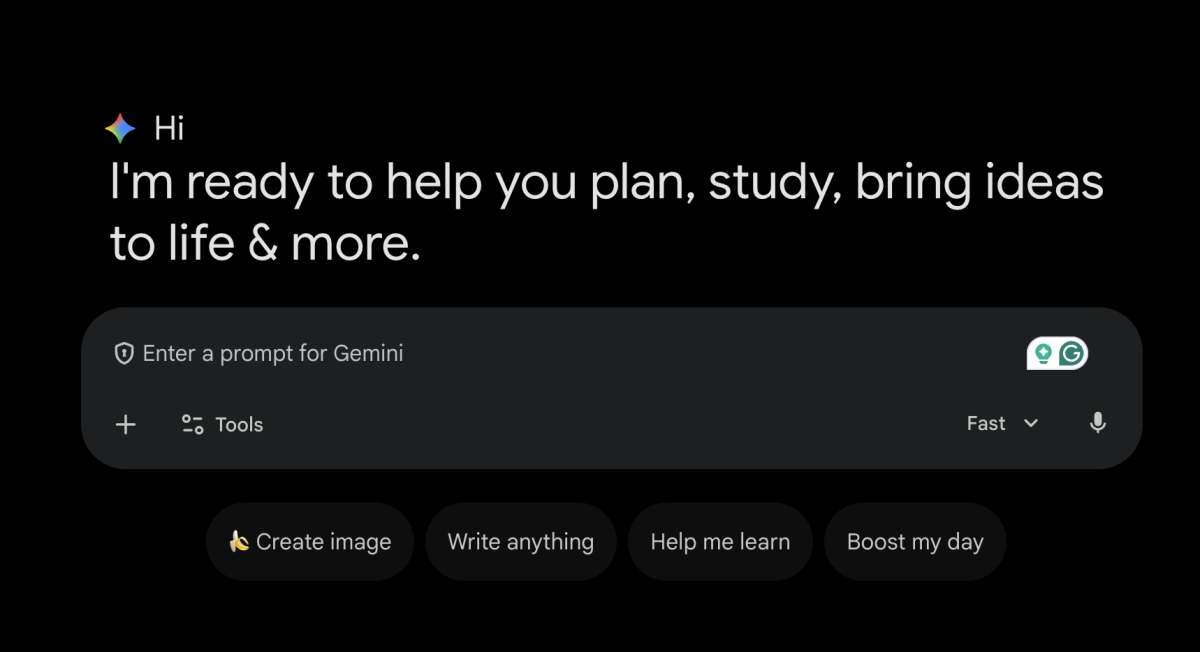
Google’s “Gemini” has grown in popularity mainly through Google’s “AI overview” on its search engine. This tool summarizes information and provides exact sources for each fact. ChatGPT is also known to fabricate quotes and facts when asked for them.
Due to the increasing popularity of ChatGPT and its increasing use in the classroom, some school districts, such as NYC, have banned it in the classroom. According to ChalkBeat New York, the NYC school district blocked ChatGPT on school devices in January of 2023, taking immediate action before the issue got worse.
Despite AI’s recent growth in popularity, it has existed in some capacity for quite some time now.
Grammarly is a writing tool powered by AI that works to improve your writing. It came out in 2009 but didn’t gain significant popularity until 2015-2017. Grammarly works similarly to a spell check that you can find on any document app, such as Google Docs or Microsoft Word.
Grammarly works differently with abilities. Basic spell checkers work as advertised, correcting any misspelled words and some punctuation. Grammarly does the same, but also provides some edits for your work.
Despite being an AI tool, Grammarly is not negatively viewed in most educational environments. Unlike other AI tools like ChatGPT or Google’s Gemini, you are unable to chat with it. Grammarly primarily works to correct your grammar and suggest edits.
However, Grammarly isn’t without faults. It has been shown to slow down computers, taking up a good bit of RAM. Grammarly’s AI isn’t perfect, and that has led to it misinterpreting what people are writing and changing it to something different from what the user originally intended.
Even though most people view Grammarly as a safe and good tool for writing, some colleges have begun to allow professors to ban the writing tool. According to the University of Notre Dame, “AI-powered editing tools like Grammarly and WordTune work by using AI to suggest revisions to your writing, so the suggestions they make are AI-generated text. This means that if your instructor prohibits the use of gen AI on an assignment or in a class, this prohibition includes the use of editing tools, unless explicitly stated otherwise.”
Classifying Grammarly and other writing tools that use AI as “generative AI” allows professors at the university to ban them from assignments and classes. This action could lead to more colleges and public school districts prohibiting Grammarly and other writing tools.
AI is also being used for research purposes. According to the University of Tennessee, “When conducting research, a researcher may engage an AI tool in human subjects research when: The AI tool collects data from humans through interaction or intervention; The AI tool is used to obtain informed consent from human participants; The AI tool is used to obtain, analyze, or otherwise access identifiable data about human research participants; or The AI tool acts as an extension or representative of the investigator(s) by answering questions for potential, current, or past human research participants.”
Regarding research, one of the most popular AI tools is Google’s Gemini, according to Foran AI Committee Member Miss Chelsea Green. Students are able to use Gemini in their research to gather sources, information, and summarize large passages/documents.
AI remains a controversial tool for educational purposes, but there are ways to use it responsibly and ethically.