Today, Monday, February 2, a rodent let the world know whether to continue to dress warmly or to put their winter clothes away and prepare for an early warm spring. It’s Groundhog Day. For better or worse, the most famous groundhog around has predicted six more weeks of winter.
Each year on February 2, people gather in Punxsutawney, Pennsylvania, to see what Punxsutawney Phil the groundhog has to say about the coming weather. If the groundhog sees his shadow upon emerging from his hole, that means there will be six more weeks of winter; if he doesn’t see his shadow, that means there will be an early spring.
Today, the groundhog saw his shadow, according to the Punxsutawney Groundhog Club. “…there is a shadow here on my ground, six more weeks of winter abound,” the website states.
But, is Groundhog Day a reliable weather forecast, or only a tradition celebrated for fun?
According to the U.S. Fish & Wildlife Service, groundhogs (a.k.a. woodchucks or whistlepigs) are stout cat-sized rodents belonging to the group of large ground squirrels in the family Sciuridae.
History teacher Mr. Brian Dooling says, “According to the National Oceanic and Atmospheric Administration (NOAA), Punxsutawney Phil has been accurate about 35 percent of the time between 2005 and 2024. In comparison, a seven-day weather forecast by a meteorologist typically has an 85 percent accuracy. I have read that some other groundhogs have better accuracy in different parts of the country.”
Not all sources report the same level of accuracy, however. According to CBS News, the groundhog has an average of 30 percent on his prediction being right in the past decade. Overall, the Stormfax Almanac says, “Phil has only been right 39 percent of the time going back to his first recorded prediction in 1887.”
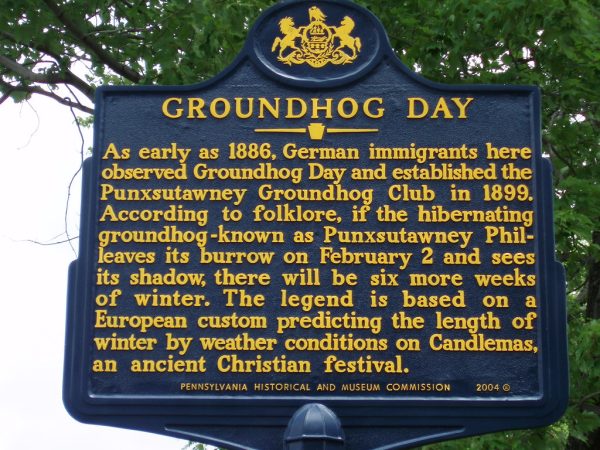
Groundhog Day began as an 18 or 19 century Pennsylvania German tradition that blended European Candlemas weather lore with hibernation folklore, substituting the groundhog for the hedgehog or badger to predict whether winter would last six more weeks, according to several online sources.
Even though scientists generally say there isn’t any real correlation between the groundhog’s prediction and the actual weather, people still choose to continue celebrating this tradition and watching what Phil predicts.
English teacher Mrs. Lauren O’Keefe comments, “I want an earlier spring; I’m tired of the cold weather.” She doesn’t put much belief in the groundhog’s prediction, but she says she still checks it out of curiosity.
Sophomore Justin Morton echoes O’Keefe’s doubt about the groundhog’s ability to predict the weather, taking even a more skeptical view of the tradition. “I don’t think Groundhog Day is useful at all because it doesn’t make sense, and the groundhog seeing its shadow doesn’t prove anything,” Morton says.